
The 90s were a strange decade for sci-fi. Studios were still figuring out what CGI could do, the internet was new enough to feel genuinely alien, and a handful of filmmakers got ambitious in ways that don't really happen anymore. What came out of that window was a run of movies that looked cheap in some places and visionary in others — and held ideas that actually stick.
Here are the ones worth tracking down.
Quick Picks
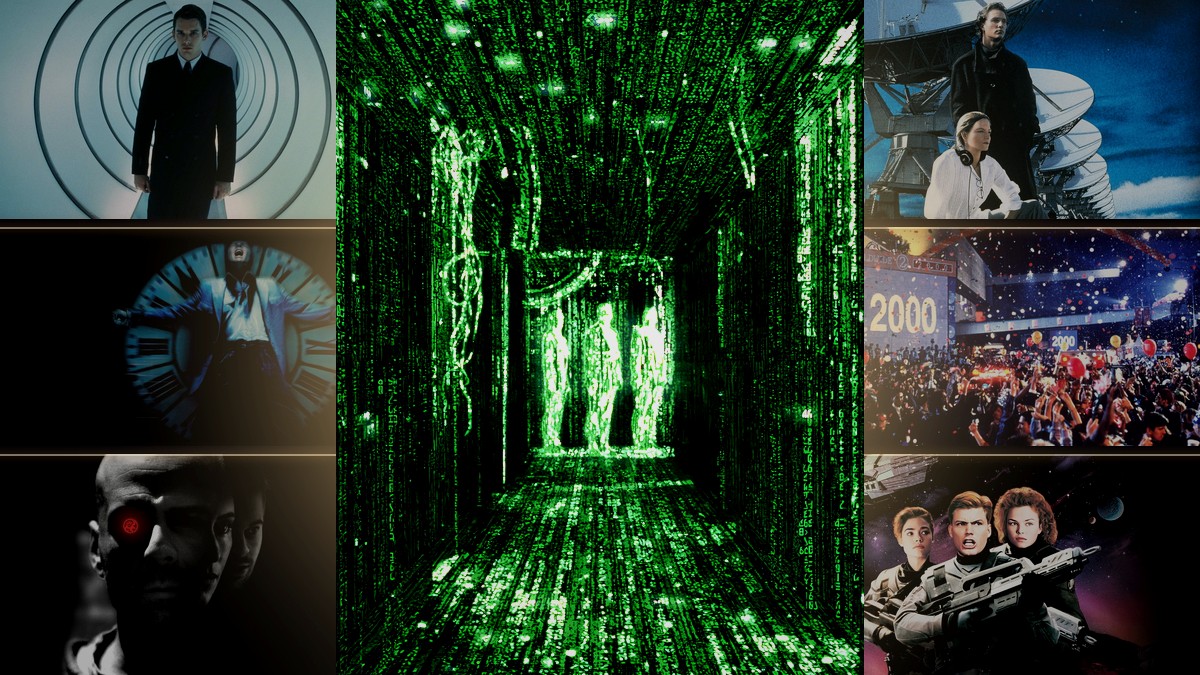
- The Matrix (1999) — Max
- Gattaca (1997) — Tubi (free), Peacock
- Dark City (1998) — Tubi (free), Plex (free)
- Twelve Monkeys (1995) — Peacock, Tubi (free)
- Contact (1997) — Max
- Strange Days (1995) — Tubi (free)
- Starship Troopers (1997) — Peacock, Paramount+
- The Truman Show (1998) — Paramount+
01
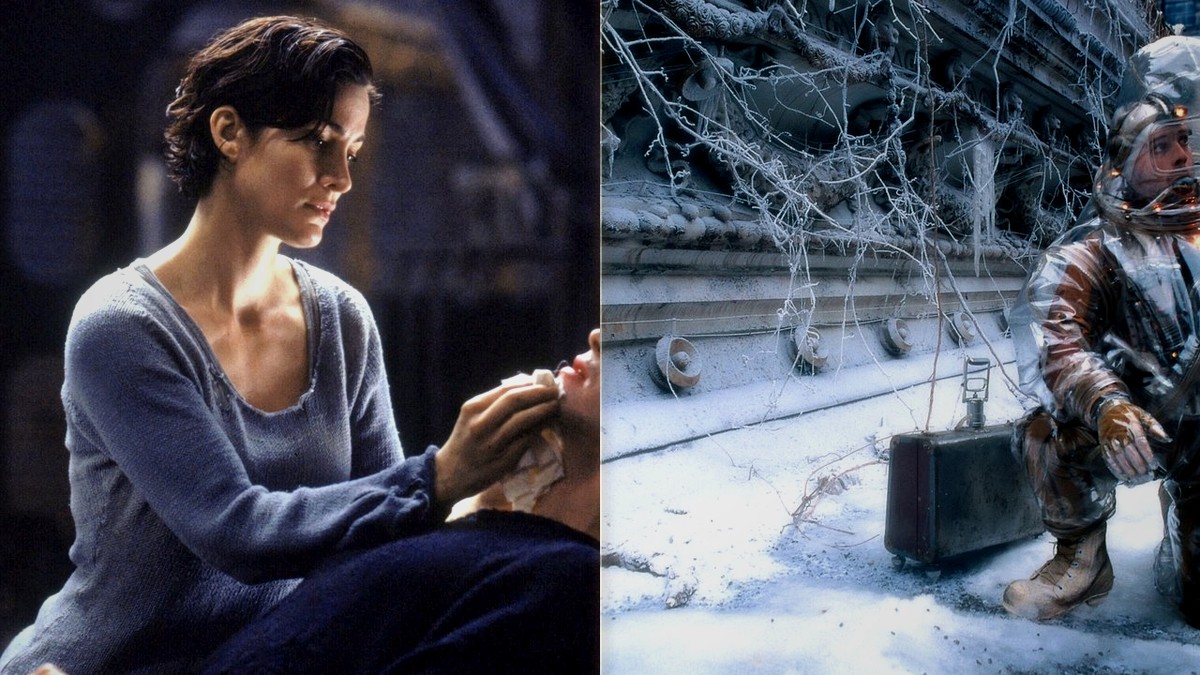
The Matrix (1999)
Directed by: The Wachowskis | Starring: Keanu Reeves, Laurence Fishburne, Carrie-Anne Moss
You know the premise. Thomas Anderson (Keanu Reeves), a programmer by day and hacker by night, gets pulled into the truth: reality is a simulation, machines run the world, and a small resistance led by Morpheus (Laurence Fishburne) is fighting back.
What's easy to forget, 27 years later, is how weird the first act of this movie is. Before the kung fu and the leather coats, it's genuinely unsettling — the sense that something is wrong without being able to name it. That's doing real sci-fi work.
The sequels muddied things, but the original is air-tight. The bullet-time stuff looked incredible then and reads as intentional stylization now. The philosophy is undergraduate-level but delivered with enough conviction to pull you along. And the action sequences still hold up in a way that post-Marvel blockbusters often don't, because every hit means something.
If you haven't revisited it since high school: it's better than you remember.
Where to stream: Max
02
Gattaca (1997)
Directed by: Andrew Niccol | Starring: Ethan Hawke, Uma Thurman, Jude Law
In a near future where genetic engineering has made "natural" births a class disadvantage, Vincent Freeman (Ethan Hawke) is an "invalid" — genetically unenhanced — who borrows the identity of a genetically superior man (Jude Law) to pursue his dream of going to space.
Gattaca is the quietest movie on this list. No action sequences, barely any violence. It's a character study inside a sci-fi premise, and it's honestly kind of perfect. The worldbuilding is all texture — the production design, the costuming, the way people talk about DNA like it's a résumé — and the story pays everything off cleanly.
The question it's asking, about whether biology should determine destiny, is not a 90s question anymore. It's a right-now question. That's why this one keeps coming up in conversations about AI, genetic testing, and designer babies. It got there first and it got there quietly.
Jude Law's performance is also one of the better ones of that decade and somehow still underrated.
Where to stream: Tubi (free), Peacock
03
Dark City (1998)
Directed by: Alex Proyas | Starring: Rufus Sewell, Kiefer Sutherland, Jennifer Connelly, Richard O'Brien
This is the one people missed. A man named John Murdoch (Rufus Sewell) wakes up in a city where it's always night, with no memory of who he is, accused of murders he doesn't remember committing. The city itself seems to be changing around him.
Dark City came out the year before The Matrix and covers genuinely similar philosophical territory — reality as construction, identity as imposed rather than innate — but it goes somewhere different and stranger. It's a noir, a horror film, and a metaphysical puzzle wrapped together, and Proyas directs it with a visual confidence that's hard to shake.
It bombed. The studio was nervous about it and buried it. Then The Matrix came out, became a cultural event, and everyone who tracked down Dark City afterward thought: these two movies are in conversation. They are.
Watch the director's cut if you can find it. The theatrical version opens with a Kiefer Sutherland voiceover that explains the plot — a note of pure studio panic — and the director's cut removes it entirely. The mystery lands much harder without the hand-holding.
Where to stream: Tubi (free), Plex (free)
04
Twelve Monkeys (1995)
Directed by: Terry Gilliam | Starring: Bruce Willis, Brad Pitt, Madeleine Stowe
A convict named James Cole (Bruce Willis) is sent back in time from a devastated 2035 to gather information about a virus that wiped out most of humanity. Except the time travel keeps going wrong, Cole keeps ending up in the wrong decade, and he's starting to wonder if he's actually just mentally ill.
This is Terry Gilliam working at the top of his range — paranoid, visually chaotic, structurally confident. The time-travel mechanics don't work if you try to logic them out too hard, and that's the point. The movie is about memory and predetermination, not about clean rules. Brad Pitt (as Jeffrey Goines, a manic psychiatric patient) gives a performance so unhinged and so precise at the same time that it still surprises people.
The ending is sad in a very specific, earned way. Not shocking for the sake of it. Just honest.
12 Monkeys also spawned a TV series that ran four seasons and was genuinely good, if you want to go deeper after.
Where to stream: Peacock, Tubi (free)
05
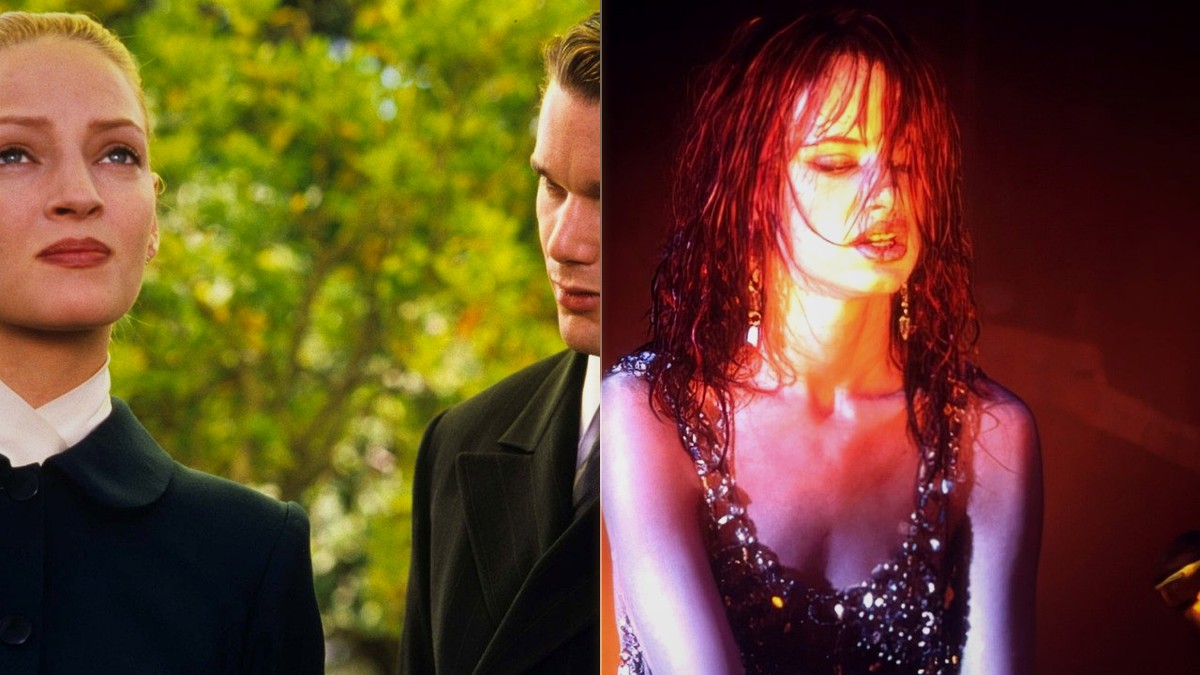
Contact (1997)
Directed by: Robert Zemeckis | Starring: Jodie Foster, Matthew McConaughey, James Woods
A SETI researcher named Ellie Arroway (Jodie Foster) picks up a signal from deep space. It turns out to be instructions for building a machine. The rest of the movie is about what happens when humanity has to decide whether to build it.
Contact is the longest movie on this list (2 hours 30 minutes) and the most patient. It's a film about science and faith and bureaucracy and ambition, and it doesn't rush any of those things. The actual first-contact moment is one of the most carefully constructed sequences in the decade — the buildup is so deliberate that when it pays off, it genuinely lands.
Jodie Foster is extraordinary. The movie doesn't talk down to its audience. And the ending, which frustrated a lot of people in 1997, is the only honest ending the story could have had.
Where to stream: Max
06
Strange Days (1995)
Directed by: Kathryn Bigelow | Starring: Ralph Fiennes, Angela Bassett, Juliette Lewis
Set in Los Angeles at the turn of the millennium — New Year's Eve, 1999 — Strange Days is about a black-market dealer (Ralph Fiennes) who trades in recorded memories. When he gets ahold of a recording connected to a murder, things escalate fast.
This one is not easy viewing. It's loud, it's intense, and a particular sequence early in the film is genuinely hard to sit through (recorded POV assault — it's brutal and intentional). But Kathryn Bigelow is doing something real here: the technology at the center of the story, memories-as-commodity, is a direct ancestor of every conversation we're having now about surveillance, deepfakes, and recorded experience.
Angela Bassett as Mace is one of the most competent, grounded action heroes of the 90s. The film belongs as much to her as to Fiennes.
Strange Days flopped badly on release and is still under-seen. It deserves better.
Where to stream: Tubi (free)
07
Starship Troopers (1997)
Directed by: Paul Verhoeven | Starring: Casper Van Dien, Dina Meyer, Neil Patrick Harris
A lot of people watched this movie as a sincere action film about soldiers killing giant bugs. That is the wrong read.
Starship Troopers is a satire of fascism so committed to its bit that most audiences missed it entirely on release. Verhoeven modeled the aesthetic directly on Nazi propaganda aesthetics — the uniforms, the fonts, the recruitment ads — and made the heroes simultaneously likeable and completely ideologically hollow. It is deeply weird, genuinely funny in a bleak way, and more relevant now than it was in 1997.
The bug fights are also fun. This movie works on multiple levels.
Where to stream: Peacock, Paramount+
08
The Truman Show (1998)
Directed by: Peter Weir | Starring: Jim Carrey, Ed Harris, Laura Linney
Truman Burbank (Jim Carrey) has lived his entire life inside a TV set. The town is a stage. The weather is controlled. Everyone around him is an actor. He just doesn't know it yet.
The idea is high-concept and the execution is flawless. Peter Weir builds the unreality gradually — little wrongnesses stacking up before Truman starts noticing them — and Jim Carrey gives one of the few genuinely restrained performances of his career. The emotional beats hit harder than you expect a "concept movie" to hit.
It's also one of the clearest early predictions of reality TV, surveillance culture, and parasocial relationship dynamics. All three of those things have gotten much more intense since 1998, which is why The Truman Show keeps getting rediscovered by new audiences.
Ed Harris as Christof is a great villain precisely because he believes he's not a villain at all.
Where to stream: Paramount+
A Few Honorable Mentions
Didn't make the full list but worth knowing about:
- eXistenZ (1999, Cronenberg) — a video game reality-spiral that out-weirds The Matrix in a lot of ways. Not for everyone.
- Cube (1997) — low-budget Canadian sci-fi horror. Six strangers wake up in a cube-shaped maze. It's very simple and very effective.
- Sphere (1998) — based on the Michael Crichton novel, messier than the book, still worth a watch if you like psychological sci-fi.
Where to Start If You Haven't Seen Any of These
Go in this order: The Truman Show, Gattaca, Dark City, The Matrix. That sequence escalates from grounded to fully philosophical and each one prepares you for the next. By the time you hit The Matrix you'll have context for what it was doing that most of its audience didn't have in 1999.
Streaming availability checked June 2026. Services change — confirm before you sit down.