
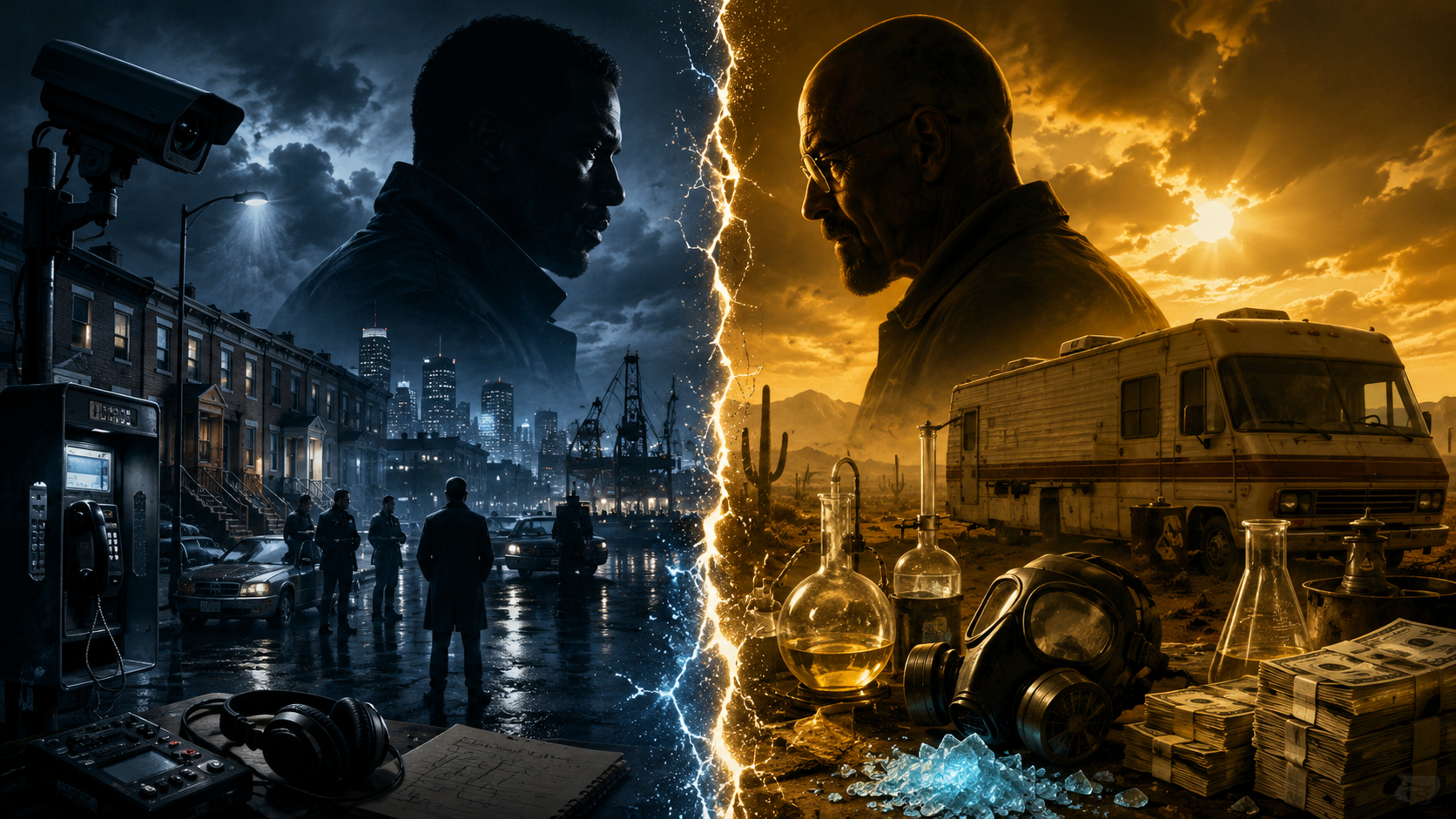
Pick any "greatest TV show ever" thread on the internet from the last fifteen years. Two titles take all the oxygen: The Wire and Breaking Bad. Everything else — The Sopranos, Mad Men, Succession, Better Call Saul — is fighting for third.
So which one actually wins?
We watched both shows again, ran them through eight head-to-head rounds, and counted the result honestly. The score came out 4–4. The verdict is not a tie.
Where to Watch Each One
- The Wire — HBO Max (subscription) or Hulu with the Max add-on
- Breaking Bad — Netflix (subscription); rent or buy on Amazon Video, Apple TV, or Fandango at Home
Tale of the Tape
| The Wire | Breaking Bad | |
|---|---|---|
| Years | 2002–2008 | 2008–2013 |
| Network | HBO | AMC |
| Creator | David Simon | Vince Gilligan |
| Seasons | 5 | 5 |
| Episodes | 60 | 62 |
| Setting | Baltimore | Albuquerque |
| Premise | The institutions of an American city | The transformation of a single American man |
Why This Debate Exists
Neither show has a real rival in its own lane. The Sopranos invented the prestige drama, but The Wire and Breaking Bad perfected two completely different versions of what came after. They aired back-to-back. The Wire ran 2002 to 2008, Breaking Bad started six months later and ran to 2013. For more than a decade, every "best TV ever" conversation has come down to these two.
They also pull viewers in opposite directions. Breaking Bad is the show people rewatch. The Wire is the show people quote in essays. Breaking Bad turned Walter White (Bryan Cranston) into a cultural figure your aunt knows by name. The Wire turned Omar Little (Michael K. Williams) into a cultural figure your aunt has probably never heard of, but every showrunner who came after has.
The real reason the debate stays alive is that both sides are right. Breaking Bad is a near-perfect five-season drama, engineered with the precision of a heist movie. The Wire is a sprawling, novelistic argument about how American cities eat their own people. They're not competing for the same crown. They're competing because the people who love them want a winner.
It's also worth noting how differently each show was received in real time. The Wire won zero major Emmys during its run. Zero. It was nominated twice for writing and never for series, lead actor, or anything else that mattered. The show's reputation as the greatest TV ever made was built almost entirely after it ended, by critics and writers and viewers who caught up later and realized what HBO had been quietly putting out for six years. Breaking Bad was the opposite — it picked up steam season by season, won 16 Emmys including back-to-back Best Drama wins, and ended at the absolute peak of its cultural moment. The Wire was discovered. Breaking Bad was anointed. That difference shapes how the debate still feels: The Wire fans tend to evangelize, Breaking Bad fans tend to defend.
So we ran them through eight rounds. Here's the scorecard.
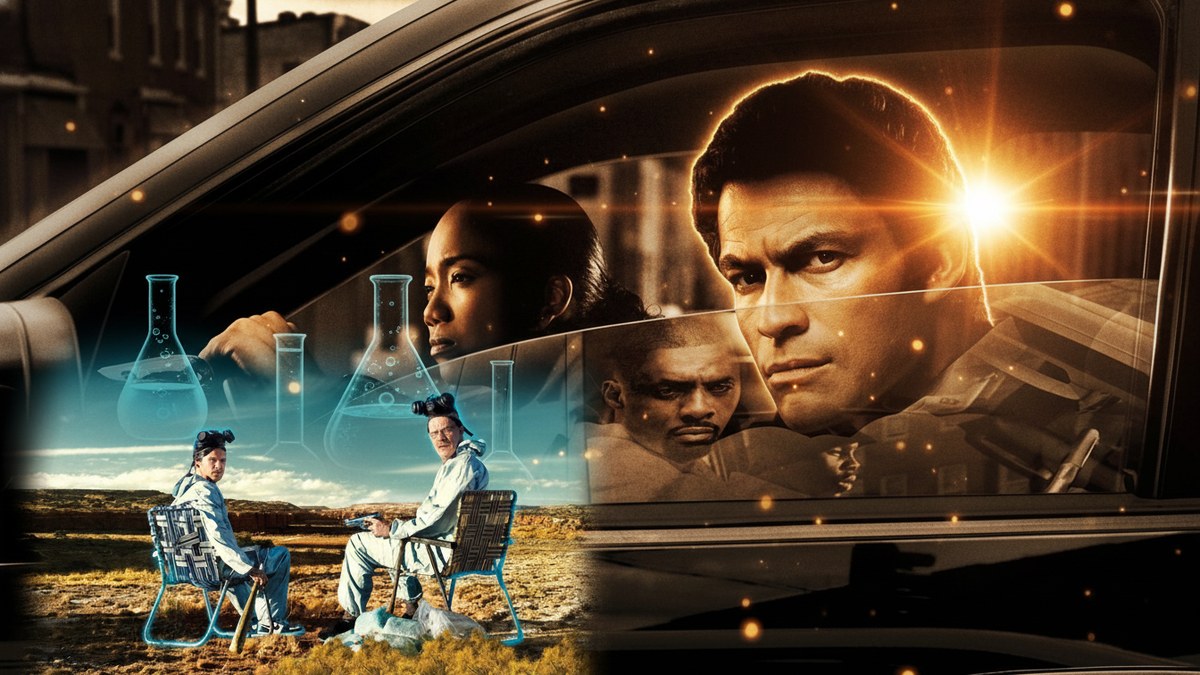
Round 1 — The Pilot
Breaking Bad's pilot is one of the great construction jobs in TV. Walter White in his underwear in the New Mexico desert, holding a gun, recording a goodbye message into a camcorder. Sirens in the distance. Then the show flashes back three weeks and unspools the chemistry-teacher-with-cancer setup with such confidence that by the closing minutes you're rooting for a man cooking meth with a kid he barely knows.
The Wire's pilot is famously demanding. It opens on Detective Jimmy McNulty (Dominic West) in a Baltimore stairwell, listening to a witness explain why everyone keeps letting Snot Boogie steal the dice pot at the corner crap game. It's beautiful writing. It's also dialect-heavy, full of unfamiliar names, and it does not tell you what kind of show you're watching. The Wire doesn't believe in pilots in the conventional sense. It believes in episode 1 of 60.
Both choices are correct for their show. But "the pilot" as a category rewards craft, accessibility, and intent landed in 60 minutes. Breaking Bad lands all three.
Round to Breaking Bad.
Round 2 — The Protagonist
Walter White is one of the most complete character arcs in any medium. Five seasons, one man, a clean line from Mr. Chips to Scarface (Vince Gilligan's actual pitch line, which is not a coincidence). Cranston's performance is a master class in incremental evil — the small choice that becomes a pattern that becomes a person. The show is about him, in him, and ultimately limited by him in interesting ways.
The Wire doesn't have a protagonist. By design. McNulty is closest, but he disappears for whole arcs. Stringer Bell (Idris Elba) feels protagonist-coded for two seasons and then dies. The actual protagonist is Baltimore. The actual protagonist is American institutional failure. The actual protagonist is the system.
This is a category The Wire has chosen not to compete in. So Breaking Bad wins it. Walter White is the more dramatic, more complete, more cinematically satisfying central character. If "greatest TV protagonist" is the question, the answer is him or Tony Soprano, and it's not close.
Round to Breaking Bad.
Round 3 — The Peak Season
Both shows have a season universally treated as their best, and both happen to be the fourth.
Breaking Bad Season 4 is Walt versus Gus Fring (Giancarlo Esposito), thirteen episodes of cat-and-mouse that end with one of the most satisfying single shots in TV history. It's tight, propulsive, and dramatically immaculate. There is not a wasted scene.
The Wire Season 4 is the school year. Four eighth-grade boys in West Baltimore — Michael, Randy, Namond, Dukie — get followed through a year of public school, foster care, the corner, and the political machine that decides whether any of them gets out. By the season finale you are wrecked. The institutions you've been watching for three years finally meet a generation of children, and the institutions win.
Breaking Bad S4 is the better thriller. The Wire S4 is the better season of television, by a margin. The ambition gap is the entire tiebreaker. Breaking Bad is doing what other great dramas do, better than they do it. The Wire is doing something only this show, in this medium, has ever done.
Round to The Wire.
Round 4 — The Supporting Cast
Breaking Bad has a strong ensemble. Aaron Paul's Jesse Pinkman is iconic. Dean Norris does career work as Hank. Bob Odenkirk's Saul Goodman became a spinoff. Mike Ehrmantraut (Jonathan Banks) is the platonic ideal of the laconic fixer. Anna Gunn's Skyler took unfair fan abuse for a layered performance the show didn't always serve.
The Wire has Omar Little. The Wire has Stringer Bell. The Wire has Bunk Moreland (Wendell Pierce), Lester Freamon (Clarke Peters), Bubbles (Andre Royo), Snoop (Felicia Pearson), Prop Joe (Robert F. Chew), Cedric Daniels (Lance Reddick), Tommy Carcetti (Aidan Gillen), Cutty (Chad Coleman), Bodie (J.D. Williams), Wallace (Michael B. Jordan, before he was Michael B. Jordan), and a roster of side characters who have more inner life than the leads of most other dramas.
It's the deepest ensemble in television history. Comparing it to anyone else's is unfair, and that's the point. The Wire didn't just have great supporting characters. It demonstrated that a show could be made out of nothing else.
A specific note on Omar Little. Michael K. Williams created a character who has no real precedent in television and arguably none in American film either — a gay Black stickup artist who robs drug dealers, lives by a strict moral code, and quotes from his grandmother's Bible. Barack Obama publicly named him as his favorite character on TV. Williams's performance moves between menace, tenderness, and grief in single scenes. Omar walking down a Baltimore street whistling "The Farmer in the Dell" while corner boys scatter in front of him is the most iconic image any prestige drama has produced. Breaking Bad doesn't have a character like that. Almost nothing does.
Round to The Wire.
Round 5 — The Ending
Breaking Bad's "Felina" is among the most satisfying series finales any major drama has ever produced. Every loose end gets tied. Walt gets what he came for, gets what he deserves, and earns a last moment with what he made. The show concludes with a confidence that almost no prestige drama pulls off. (See: Game of Thrones, Lost, Dexter, every other show that flinched at the finish line.)
The Wire's ending is the most contested element of the show. Season 5's serial-killer storyline — McNulty fakes a string of murders to free up resources — strains the show's commitment to realism in a way the previous four seasons never did. The newspaper-industry plotline is also weaker than the institutions it followed. The actual final episode is moving. The arc that gets you there is the show's least convincing.
You can argue the cycle-keeps-going coda — Dukie becoming Bubbles, Michael becoming Omar, Carcetti's compromises matching Royce's — is the only honest ending the show could have. You'd be right. But Breaking Bad sticks the dismount harder.
Round to Breaking Bad.
Round 6 — The Single Best Episode
"Ozymandias" (Breaking Bad S5E14) is regularly cited as the greatest single episode of television ever made. Rian Johnson directed it. Hank dies. Walt's family unravels in real time. The phone call. The baby. The shot of Walt rolling the barrel through the desert. There is a strong case it's the best hour of TV in this century.
The Wire's contender is "Middle Ground" (S3E11), the episode where Stringer Bell dies. Or "Final Grades" (S4E13), the season finale that breaks every viewer who's spent thirteen episodes praying for those four boys. Or "-30-" (S5E10), the series finale, with all its compromises.
These are not lesser episodes. "Middle Ground" is one of the great hours of television, period. "Final Grades" might be more devastating than anything in Breaking Bad. But "Ozymandias" wins on cite count, on cultural footprint, and on the simple fact that it is the high-water mark of what dramatic TV can be in a single sitting.
Round to Breaking Bad.
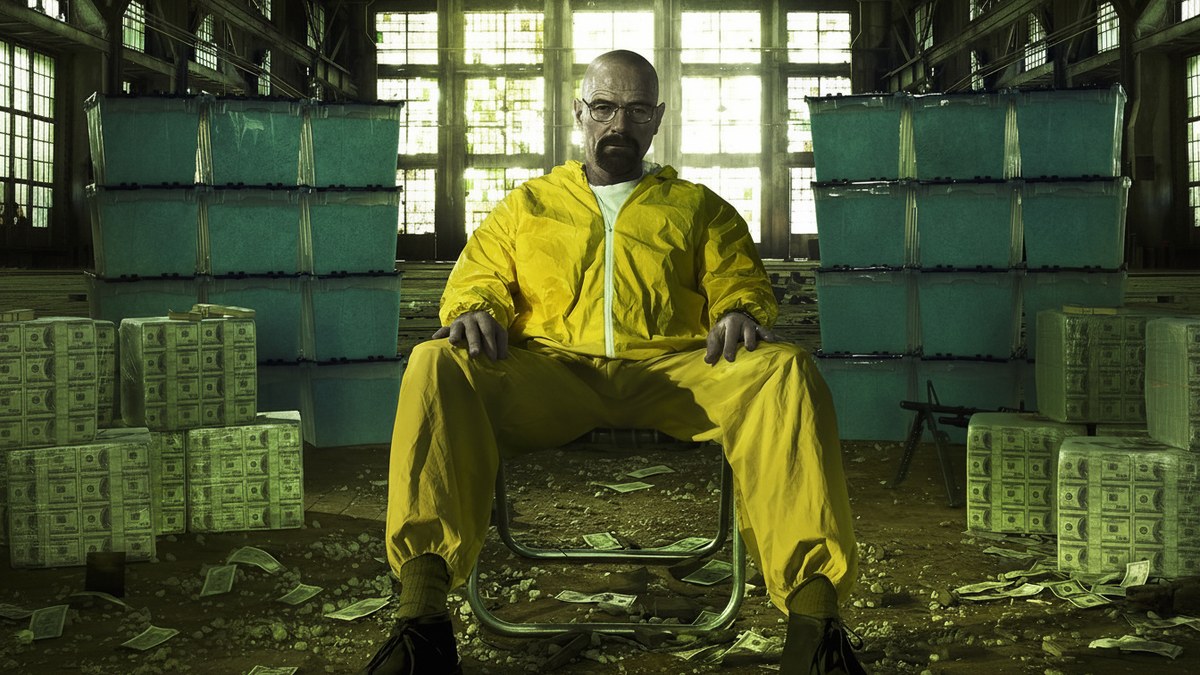
Round 7 — The Rewatch
Breaking Bad rewards rewatches. You see the foreshadowing more clearly. You catch the small choices that become the big ones. The dread anticipates itself. It's a satisfying loop.
The Wire rewatches differently. On the first pass you understand maybe 70% of what's happening. The dialect, the politics, the institutional rules, the way characters move between systems — a lot of it doesn't land until you've seen it once. The second viewing is when the show actually opens up. The third viewing, you start catching parallels across seasons. The fourth, you see the full structural argument. The fifth, you find new things again.
This is one of the few cases where a show genuinely rewards a fifth viewing more than a first. It's part of why every TV writer of the last fifteen years cites The Wire as their favorite. They've watched it more times than you have, and they're still finding things.
Round to The Wire.
Round 8 — What It Changed About TV
Breaking Bad perfected the antihero-protagonist drama that The Sopranos invented and Mad Men refined. It is the cleanest, sharpest version of a form that already existed. Its influence is real, but it's the influence of a final draft, not a blueprint.
The Wire invented the form most prestige TV now lives in. The novelistic, multi-season, ensemble-driven argument-as-show. Treme came directly from it. Show Me a Hero. We Own This City. But also: Better Call Saul's patient world-building. Succession's ensemble logic. The Bear's specificity about a place. The Penguin's institutional sprawl. The "city as character" lineage of The Deuce, Atlanta, Treme again. Even shows nothing like The Wire on the surface — Severance, Andor — owe its proof of concept that a TV drama could carry the weight of a novel.
You can draw a line from The Wire through every prestige drama that has tried to be more than entertainment since 2008. You can't draw the same line from Breaking Bad.
Round to The Wire.
The Verdict
Final round count: The Wire 4, Breaking Bad 4.
The card is split evenly, and the tiebreaker has to come from somewhere. We've already been arguing it: Breaking Bad wins on the categories that reward dramatic craft — pilot, protagonist, ending, single peak episode. The Wire wins on the categories that reward ambition, depth, and what the medium itself can do — peak season, ensemble, rewatch, influence.
So the question becomes what "greatest" actually means.
If "greatest" means most perfectly engineered five-season story TV has ever told, the answer is Breaking Bad and we'd defend it. The construction is immaculate. The performance is one of the best in the medium's history. The ending is the kind of clean drop most shows can't manage. It is a flawless drama.
If "greatest" means the show that proves television can do things film and books can't — the show that uses its 60 hours to argue something about how the world actually works, with a depth no shorter form could carry — the answer is The Wire. Its rounds win the bigger questions.
We pick The Wire. Not because it's the more enjoyable rewatch. Not because we love it more. Because the bar for "greatest TV ever made" has to include what only TV could have made, and The Wire is the clearest case of that argument the medium has produced.
Breaking Bad is the better drama. The Wire is the greater show.
Now go watch them both again.
Is the Wire Really Better Than Breaking Bad?
By the rounds that decide the "greatest TV ever" question — ambition, ensemble depth, rewatch reward, influence on the medium — yes. By the rounds that decide which is the more polished, satisfying, dramatically tight five-season story, no. Breaking Bad wins on craft and The Wire wins on scope. If you're asking which is the better show as a piece of art, The Wire. If you're asking which is the more enjoyable show to actually watch, plenty of viewers will tell you Breaking Bad. Both groups are right.
Which Show Should You Watch First?
Breaking Bad. It's the more accessible entry point — clearer protagonist, cleaner pilot, the kind of immediate dramatic stakes that hook a viewer in the first hour. Then watch The Wire second, when you've built the patience for a slower opening and a denser world. Watching them in this order also tracks chronologically with how prestige TV was actually built, and watching The Wire with Breaking Bad fresh in your head makes the differences in approach much easier to feel.
Pick any thread on the internet about the greatest TV show ever made. The two names will keep coming up. Now you know how to answer.