
The Seinfeld Chronicles premiered on July 5, 1989. It got middling reviews, finished second in its Wednesday-night time slot against a CBS police drama nobody remembers, and almost got cancelled. NBC ordered four more episodes mostly because the entertainment division had Bob Hope special money lying around. Those four episodes ran in summer 1990. The show got renamed Seinfeld and kept going.
Thirty-six years later, every single sitcom currently in production owes it something.
The standard claim — that Seinfeld is the greatest sitcom ever made — gets repeated until it stops meaning anything. So let's actually have the argument. Show by show, claim by claim. Where does the case for Seinfeld hold up, where does it struggle, and is the standard verdict still right in 2026?
The short answer: yes. The longer answer is more interesting than the short one.
The Case for Greatest
It rejected the rules
Every sitcom before Seinfeld had a rule: at the end of the episode, someone had to learn something. Lucy and Ricky reconciled. Sam and Diane had a moment. Cliff Huxtable taught Theo a lesson. The half-hour comedy was structured as a small moral universe in which characters were presented with a problem, made a mistake, recognized the mistake, and grew slightly.
Larry David's rule for Seinfeld was famously the opposite: no hugging, no learning. By the time the show found its voice in season three, every episode was structured to ensure that the four main characters ended exactly where they started — petty, selfish, annoyed at the universe, having gained nothing. This sounds like a small structural choice. It's not. It's a complete rejection of the moral architecture sitcoms had been built on for forty years.
Without that choice, Curb Your Enthusiasm doesn't exist. It's Always Sunny in Philadelphia doesn't exist. Veep doesn't exist. The Office (US) — which on paper is a workplace comedy with a heart — would not have been allowed to make Michael Scott as openly cringey as it did without the Seinfeld permission slip preceding it. The whole post-2000 wave of antihero comedy starts here.
The four-character engine
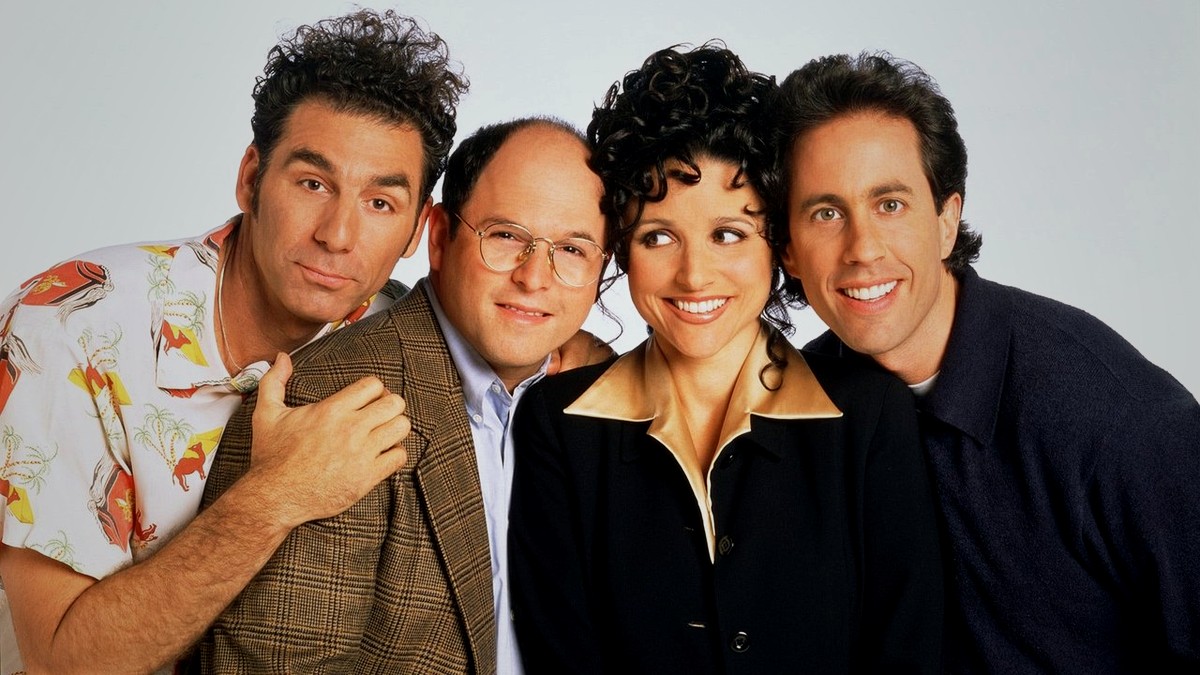
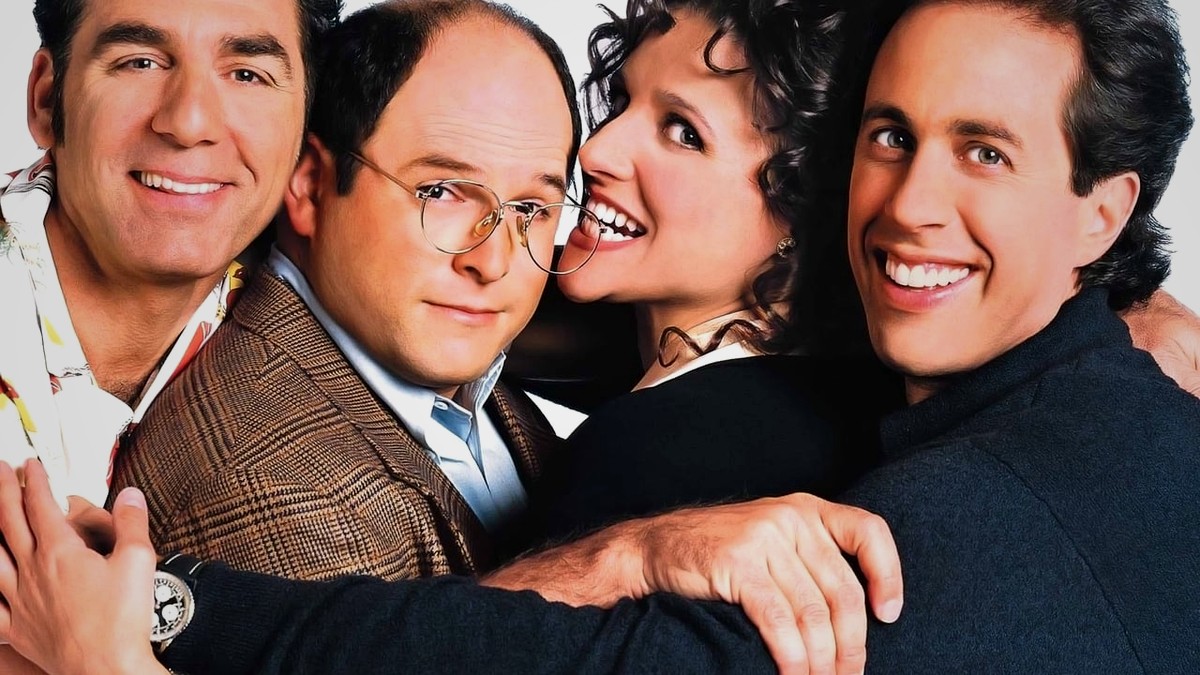
Most sitcoms built around an ensemble pick a protagonist and let the others orbit. Seinfeld built around an actual four-pointed engine: Jerry, George, Elaine, and Kramer. Each character was the funniest in scenes with the right partner. Jerry and George doing the coffee-shop dialogue. George and Elaine doing the office-aside. Kramer crashing into Jerry's apartment. Elaine reacting to all three.
The show's writers (Larry David and Jerry Seinfeld for the first seven seasons; a strong rotating room afterward) figured out which character pairings produced which kinds of comedy and structured episodes around the math. Almost no other sitcom is this disciplined about its character chemistry. Cheers came close. Frasier came close. Most others picked one engine and stuck with it.
The contributions to vocabulary
Most sitcoms produce a couple of catchphrases. Seinfeld permanently rewrote the English language for several million speakers.
"Yada yada yada." "Master of my domain." "Double-dipping." "Close talker." "Soup nazi." "Festivus" (which, somehow, has become a real holiday some people actually observe). "Shrinkage." "Spongeworthy." "Re-gift." "These pretzels are making me thirsty."
The list is genuinely longer than this. The remarkable thing is that most of these aren't just catchphrases — they're useful words. There was no efficient way to describe the social act of double-dipping a chip before Seinfeld gave it a name. The vocabulary export is one of the cleanest measures of cultural penetration any TV show has ever produced.
The peak seasons are flawless
Seasons four through seven are the strongest run any sitcom has put together. "The Contest." "The Marine Biologist." "The Outing." "The Chinese Restaurant" (technically season two but it set the template). "The Parking Garage." "The Soup Nazi." "The Junior Mint." "The Bubble Boy." "The Pen." "The Dinner Party." "The Pitch." Episode after episode that ranks among the all-time best in the form, sustained over four seasons.
Most great sitcoms have one season that hits this level. Seinfeld has four consecutive ones. The closest competitor in this category is probably The Larry Sanders Show (which is Seinfeld's structural cousin and didn't run as long), or maybe Frasier in its peak run. The total density of unimpeachable episodes is what holds the case for greatest.
The structural innovation
Each season-four episode tracked an A-plot, a B-plot, and sometimes a C-plot, all of which converged in the final scene through some piece of escalating coincidence. This was unusual at the time and remained unusual after. Most sitcoms keep their plots cleanly separated. Seinfeld was running a clockwork comedy in which Kramer's pasta maker would somehow connect to Elaine's boss's mistress by act three.
Larry David has said in interviews that this convergence structure was sometimes the entire point of the writing process — the writers would generate three unrelated story ideas and then spend the week figuring out how they could collide. The form became its own running joke. Audiences started anticipating the convergence and the show got smarter at hiding it.
Where the Case Struggles
The cultural representation
This is the strongest argument against the show being the greatest sitcom ever, full stop. Seinfeld's New York is even whiter than Friends's New York, and the show got worse on this over time rather than better. The Indian character of Babu Bhatt was constructed mostly as an accent. "The Cigar Store Indian" episode features a series of jokes about Native American imagery that the writers' room presumably thought were ironic and that 2026 viewers will not.
There's a defense of this that goes "the show was about petty New Yorkers, and petty New Yorkers are casually racist," and that defense isn't entirely wrong. The show is satirizing its own characters, not endorsing them. But satire requires the audience to clearly understand the framing, and a number of Seinfeld episodes don't make the framing clear enough to land as satire. They land as the joke they appear to be.
This is a real ceiling on the case for greatest. Better sitcoms — All in the Family, Cheers, The Cosby Show (with caveats), The Fresh Prince of Bel-Air — were doing more interesting cultural work in their own ways. Seinfeld was doing comedy at a higher technical level than any of them. Both can be true.
The finale
A show this committed to "no learning" needed to land its finale somewhere unique, and Larry David's solution was to put the four main characters on trial for being bad people and have them convicted. The episode is structurally clever — every character witness from nine seasons returning to testify is a great idea. The execution is uneven. Most fans rank "The Finale" as the show's worst-paced single episode. Some rank it as a genuine misfire. Almost nobody calls it great.
Which is fine. Most great sitcoms have weak finales (Friends's finale is also fine, not great). But "no weak finale" is part of what would make a show airtight, and Seinfeld doesn't have it.
The "observational not emotional" problem
The criticism most often raised against Seinfeld in modern conversations is that it doesn't make you feel anything. The show is engineered to keep its characters at a distance from the audience and from each other. There are no Ross-and-Rachel moments. There are no Niles-and-Daphne moments. The closest thing to an earned emotional beat across nine seasons is George briefly losing his fiancée Susan in season seven, and the show plays even that for a joke (her death by toxic envelope glue).
If your standard for "greatest sitcom" includes emotional resonance, Seinfeld will lose to Cheers, Frasier, Friends, Parks and Recreation, or Schitt's Creek. If your standard is purely comedic precision and structural innovation, it almost certainly wins. Which standard is the right one is genuinely up for debate.
The Larry David problem
Larry David left the show after season seven. He came back for the finale. The seasons in between — eight and nine — are not as good as the four that preceded them. The episodes are still funny. The writing is still sharp. But the structural rigor that made seasons four through seven feel like clockwork starts to loosen. Some episodes feel like they're chasing their own tropes rather than generating new ones.
This is a small ding against the case for greatest. A truly airtight argument would have all nine seasons at the same level. Seinfeld doesn't quite. The drop-off between seasons seven and eight is real, even if the drop is from "best sitcom ever" to "still better than 95% of competitors."
So Is It the Greatest?
If "greatest" means most influential on the form, most permanently absorbed into the culture, most structurally inventive, most consistently funny across its peak seasons — yes, it's the greatest. The case is genuinely closed.
If "greatest" means most emotionally resonant, most culturally representative, most thematically ambitious about the world outside its four characters — no, Seinfeld doesn't win that argument. Other sitcoms have done more on those terms.
The honest verdict is that Seinfeld is the greatest comedy on television. It is one of several great sitcoms. The distinction between a comedy and a sitcom is real. Seinfeld won the comedy argument so completely that it permanently shifted the category. Most viewers under forty now expect their sitcoms to be at least a little mean, a little uncomfortable, a little willing to leave the characters where they started. That's the Seinfeld footprint. It's still there.
In 2026, watching the show fresh, what hits hardest isn't the jokes (though the jokes hold up). It's the discipline. Every episode is doing more structural work than almost anything currently being produced. The show was made with an obsessive level of craft, and you can feel it in every scene.
That's the real answer to "greatest sitcom ever." Not whether Seinfeld makes you laugh harder than I Love Lucy or Cheers. Whether it's the cleanest piece of craft in the form. It is.
Where to Watch Seinfeld Now
All nine seasons are streaming on Netflix, where they've been since October 2021 in a deal reportedly worth more than $500 million. Episodes can also be purchased on Amazon Prime Video, Apple TV, and Fandango at Home. The Blu-ray box set is the best format for the curious — the bonus features include some of Larry David's clearest commentary on the writing process.
What Is the Most Popular Seinfeld Episode?
By awards and cultural cite count, "The Contest" (season 4, episode 11) and "The Marine Biologist" (season 5, episode 14) are the two most discussed episodes. "The Soup Nazi" is the most quoted. "The Parking Garage" is the most structurally daring. "The Chinese Restaurant" is the episode the show points to as the moment it figured out what it was. Picking the best is roughly equivalent to picking your favorite Beatles album. The defensible answers are clustered together in the same general territory.
If Seinfeld is the show that proved sitcoms could be merciless, Friends is the show that proved they could be comforting. Both shows are foundational. Neither is dispensable. Anyone arguing for one and dismissing the other is missing what each actually contributed.